Can a Blood Test Detect Cancer? What Every Person in Dubai Needs to Know
I have spent more than a decade in oncology clinics, and if there is one sentence I hear most often after a cancer diagnosis, it is this: “I wish I had found out sooner.” It is the statement that haunts every oncologist. It is also the statement that drives me to talk about cancer marker blood tests — because early detection genuinely saves lives, and right now, getting tested has never been easier or more accessible in Dubai.
In this article, I want to walk you through exactly what blood tests can tell us about cancer, which markers matter for which cancers, who should get tested, and how to take the practical step of getting screened without setting foot outside your home.
What Is a Cancer Marker Blood Test?
A cancer marker — often called a tumour marker — is a substance found in the blood that is produced either by cancer cells or by the body in response to cancer. These markers can be proteins, hormones, enzymes, or even fragments of DNA. While no single blood test diagnoses cancer with absolute certainty on its own, a panel of tumour markers gives clinicians — and patients — a powerful window into what may be happening inside the body.
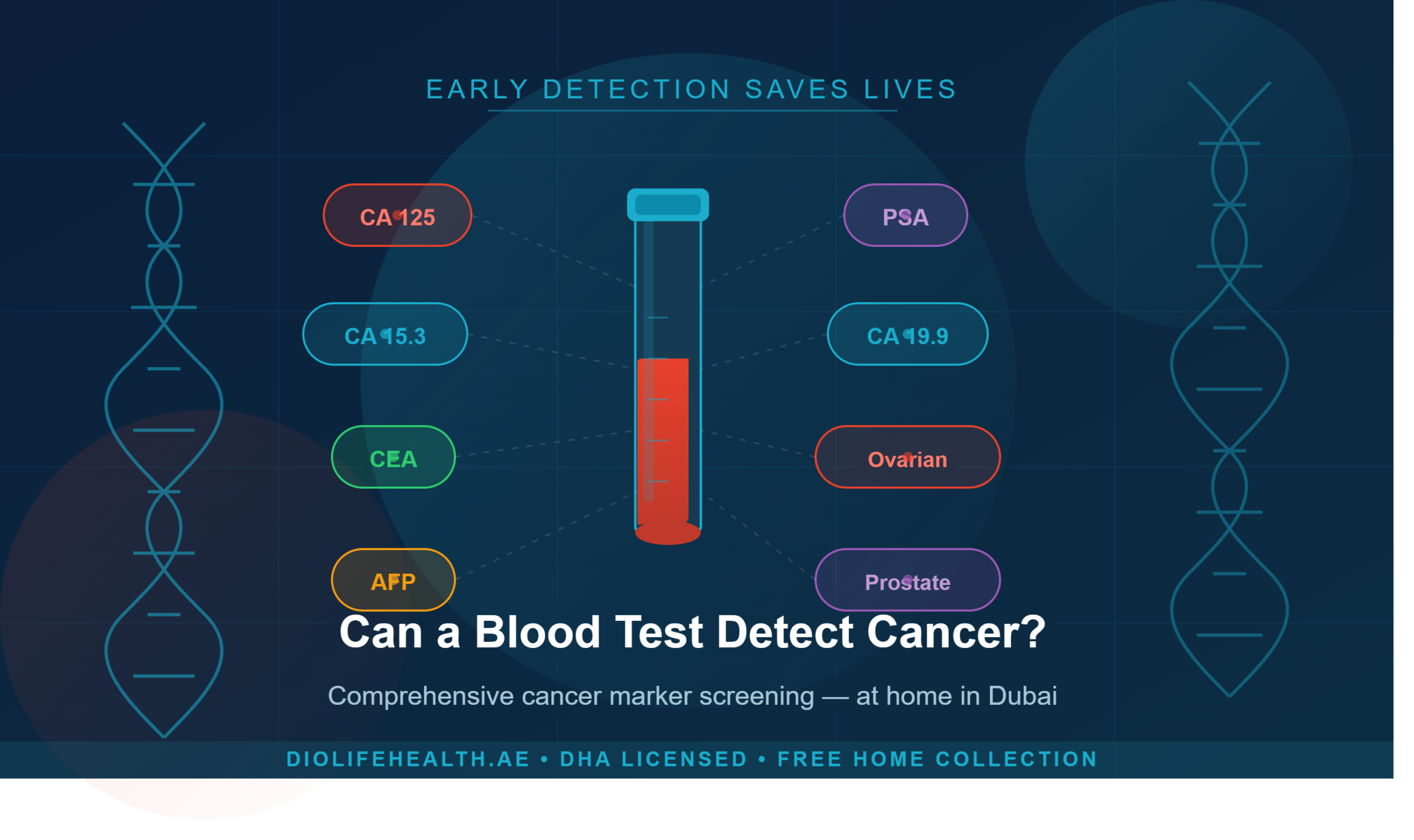
The key word here is panel. When we run multiple markers together, the combined picture becomes far more clinically meaningful. That is why a comprehensive cancer markers package — like those offered at Dio Life Home Health Care — tests five or more distinct biomarkers in a single blood draw, covering several of the most common cancers simultaneously.
Think of it this way: if you were checking the health of your car, you would not look at just one gauge. You would check the oil, the battery, the tyres, and the engine warning light all at once. Cancer markers work on the same principle.
Which Cancers Can a Blood Test Detect or Indicate?
This is the question I am asked most often by patients and families. The honest answer is: quite a few — and the list is growing as science advances. Let me go through the cancers that are covered by the most widely used clinical markers.
1. Ovarian Cancer — CA 125
Ovarian cancer is often called the ‘silent killer’ because it rarely causes obvious symptoms until it has reached an advanced stage. The CA 125 marker is the primary blood test used to help identify ovarian cancer. Elevated CA 125 levels can signal the presence of ovarian cancer, though it can also rise in other benign gynaecological conditions, which is why it should always be interpreted by a doctor in context.
Who should test for this? Women over 35 with a family history of ovarian cancer, women experiencing persistent bloating, pelvic pain, or unexplained weight changes, and women with BRCA gene mutations should prioritise CA 125 testing regularly.
2. Breast Cancer — CA 15.3
Breast cancer is the most commonly diagnosed cancer in women globally. The CA 15.3 marker is used primarily to monitor known breast cancer — particularly to track how treatment is working or to detect recurrence. In a screening context, it contributes to a broader picture alongside physical examination and imaging.
I often tell my female patients: mammograms are essential, but adding CA 15.3 to your annual blood panel gives you one more data point — especially valuable if you have dense breast tissue where mammograms can be less clear.
3. Prostate Cancer — PSA (Prostate-Specific Antigen)
For men, prostate cancer is among the most prevalent cancers worldwide. The PSA test is the most established blood test for prostate cancer screening. Elevated PSA levels can indicate prostate cancer, though they may also reflect a benign enlarged prostate or infection.
In my clinical experience, men over 45 — and men over 40 with a family history of prostate cancer — benefit enormously from regular PSA testing. When caught early, prostate cancer is highly treatable. The PSA test has been part of saving countless lives over the past three decades.
4. Liver Cancer — AFP (Alpha-Fetoprotein)
AFP is a protein normally produced in large quantities by a developing foetus. In adults, elevated AFP levels are closely associated with liver cancer (hepatocellular carcinoma), particularly in individuals with chronic hepatitis B or C, or cirrhosis.
If you have a history of liver disease, are a carrier of hepatitis B or C, or have been a heavy drinker over many years, AFP testing is something I would strongly advocate discussing with your physician. Liver cancer caught at an operable stage has dramatically better outcomes than when it is found late.
5. Pancreatic and Gastrointestinal Cancers — CA 19.9
The CA 19.9 marker is most strongly associated with pancreatic cancer and certain gastrointestinal cancers, including cancers of the bile duct and gallbladder. Pancreatic cancer has one of the lowest survival rates of all cancers — not because it is inherently more aggressive in every case, but because it is almost universally diagnosed very late.
This is precisely why I am passionate about including CA 19.9 in preventive panels. For individuals with a family history of pancreatic cancer, long-standing pancreatitis, or new-onset diabetes in middle age with no clear cause, this marker adds important clinical intelligence.
6. Colorectal Cancer — CEA (Carcinoembryonic Antigen)
CEA is a protein that, when elevated, can suggest the presence of colorectal cancer among other malignancies. It is also used to monitor treatment response and detect recurrence in patients who have already been treated for bowel cancer. Combined with regular colonoscopy screening, CEA adds an important layer of surveillance.
Colorectal cancer incidence is rising in the Gulf region, partly due to dietary and lifestyle shifts. This is something I discuss with a large number of my patients in the UAE every year.
7. Lung Cancer — CEA
CEA is not exclusive to colorectal cancer. Elevated CEA levels can also indicate lung cancer, and it is often included in lung cancer monitoring panels. Smokers, ex-smokers, and individuals with significant occupational exposure to carcinogens represent the highest-risk group for lung cancer and may benefit from regular CEA monitoring alongside chest imaging.
8. Thyroid Cancer — TSH and Thyroglobulin
While standard thyroid function tests (TSH) are not cancer markers per se, elevated or suppressed TSH combined with clinical symptoms can prompt investigation for thyroid cancer. Additionally, thyroglobulin is used as a tumour marker in patients who have already been treated for thyroid cancer. If you have a thyroid nodule, a goitre, or a family history of thyroid cancer, thyroid function testing is a logical and low-cost starting point.
9. Blood Cancers — Complete Blood Count (CBC)
Leukaemia and other forms of blood cancer are often first suspected through a simple complete blood count (CBC). Abnormalities in white cell count, red cell count, or platelet levels can trigger further investigation. While the CBC alone does not diagnose blood cancer, it is frequently the first clue — and it is one of the most affordable, widely available blood tests in medicine.
Who Should Get a Cancer Markers Blood Test?
I want to be direct here: cancer markers are not exclusively for people who feel unwell. In fact, they deliver the greatest value as a preventive tool in people who feel perfectly fine. Here is how I think about risk in my own clinical practice:
- Men and women over 40 with no particular family history — annual cancer marker panels are a sensible part of a comprehensive health check
- Individuals with a family history of any cancer, particularly first-degree relatives (parents, siblings)
- Smokers and ex-smokers — lung, bladder, and oropharyngeal cancer risk is significantly elevated
- People with chronic liver disease, hepatitis B or C, or cirrhosis — AFP testing is particularly important
- Individuals with inflammatory bowel disease or a history of colorectal polyps
- Women on hormone replacement therapy or with hormonal imbalances — elevated risk for breast and ovarian cancer
- People experiencing unexplained fatigue, weight loss, or persistent pain — where a broad cancer panel can either provide reassurance or direct urgent further investigation
- Individuals with obesity or type 2 diabetes — risk factors for pancreatic, liver, and colorectal cancer
Even if you fall into none of these categories, a cancer markers test at 40, 45, and 50 is — in my view — one of the wisest investments you can make in your long-term health.
Understanding Your Cancer Marker Results: What Elevated Levels Actually Mean
This is where I always spend careful time with patients, because misinterpreting results can cause unnecessary panic — or, conversely, false reassurance. Here are the principles I follow:
An elevated marker does not automatically mean you have cancer. Many benign conditions — endometriosis, liver disease, inflammation, or even pregnancy — can raise certain markers. Conversely, some cancers in early stages may not yet produce detectably elevated markers.
Results must always be interpreted by a qualified physician who can consider your full clinical picture: symptoms, family history, physical examination, and potentially follow-up imaging. This is exactly why Dio Life includes a free doctor consultation for report interpretation with every cancer marker test.
Think of the marker result as a flag on a map — it tells you where to look more carefully, not necessarily what you will find there.
Why Early Detection Makes Such a Profound Difference
In oncology, we talk about survival rates in terms of 5-year survival — the percentage of patients alive five years after diagnosis. The contrast between early and late-stage survival rates is, frankly, staggering:
- Breast cancer 5-year survival: ~99% when caught at Stage I vs ~27% at Stage IV
- Ovarian cancer 5-year survival: ~93% at Stage I vs ~29% at Stage IV
- Colorectal cancer 5-year survival: ~91% at Stage I vs ~15% at Stage IV
- Prostate cancer 5-year survival: nearly 100% when localised vs ~32% when distant metastases are present
- Liver cancer 5-year survival: ~35% at early stage vs less than 5% at late stage
These numbers are not abstract statistics. Behind every percentage point is a person who went home to their family, watched their children grow, and lived a full life — because their cancer was found in time.
A blood test is not a guarantee of early detection — but it is one of the most practical, accessible tools we currently have to tilt the odds in your favour.
The Dio Life Cancer Markers Test: What Is Included?
For patients in Dubai seeking a convenient, comprehensive, and clinically rigorous cancer screening blood test, the cancer marker packages available through Dio Life Home Health Care cover the most clinically relevant biomarkers in a single draw.
Cancer Markers Test for Women — CA 125, CA 15.3, CEA, AFP, CA 19.9
This female-specific panel screens for markers associated with ovarian cancer (CA 125), breast cancer (CA 15.3), colorectal and lung cancers (CEA), liver cancer (AFP), and pancreatic cancer (CA 19.9). It is designed to give women a broad, evidence-based overview of their cancer risk profile from a single blood sample.
Book the Cancer Markers Test for Women in Dubai →
Cancer Markers Test for Men — PSA, CEA, AFP, CA 19.9
The male panel prioritises prostate cancer (PSA) alongside markers for colorectal, lung, liver, and pancreatic cancers. It provides men with an actionable, affordable snapshot of some of their most significant cancer risks.
Book the Cancer Markers Test for Men in Dubai →
What Makes Dio Life’s Service Stand Out?
- Free home sample collection across Dubai — a trained, DHA-licensed nurse comes to you
- Tests processed at DHA-registered, accredited laboratories
- Results delivered within 24–48 hours via Email or WhatsApp
- Complimentary doctor consultation to interpret your results — no clinical confusion, no unanswered questions
- Competitively priced packages with current discounts making comprehensive cancer screening genuinely affordable
Frequently Asked Questions About Cancer Blood Tests
Is a blood test enough to diagnose cancer?
No. A blood test alone cannot diagnose cancer. Elevated cancer markers must be followed up with further investigation — typically imaging (ultrasound, CT, MRI) and in some cases a biopsy — before any diagnosis is made. A marker panel is a screening and monitoring tool, not a diagnostic verdict. Always consult a qualified physician to interpret your results.
Do I need to fast before a cancer marker blood test?
Fasting requirements vary by test. For most cancer marker panels, a fast of 8–10 hours is recommended for certain components. The Dio Life team will advise you on preparation when you book your test. In general, staying well-hydrated with water is encouraged.
How often should I get a cancer markers test?
For most healthy adults over 40 with no family history of cancer, an annual or biennial cancer marker panel is a reasonable approach. Individuals with elevated risk factors — family history, chronic liver disease, long-term smoking, or hormonal conditions — may benefit from more frequent testing, as advised by their doctor.
Can cancer markers come back elevated due to something other than cancer?
Yes — and this is an important point. CA 125 can be raised by endometriosis, fibroids, or pelvic inflammatory disease. AFP can be raised in liver disease. PSA can be elevated in benign prostatic hyperplasia. CEA can rise in smokers and in inflammatory bowel conditions. Elevation does not mean cancer — it means further investigation is warranted. Context, clinical history, and physician interpretation are always essential.
Is a blood test for cancer detection available at home in Dubai?
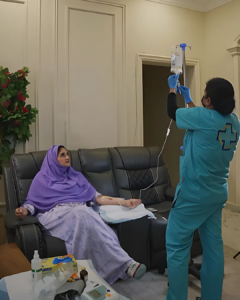
Yes. Dio Life Home Health Care offers home sample collection for cancer marker blood tests across Dubai. A DHA-licensed nurse visits your home or office, collects the sample, and your results are processed at an accredited laboratory and delivered to you digitally within 24–48 hours, along with a complimentary doctor consultation.
What is the difference between the male and female cancer marker packages?
The female package (CA 125, CA 15.3, CEA, AFP, CA 19.9) includes markers specifically relevant to women’s cancers, including ovarian and breast cancer markers. The male package includes PSA for prostate cancer screening alongside the shared markers for liver, pancreatic, and colorectal/lung cancers. Both packages are designed to provide gender-appropriate comprehensive coverage.
A Note From the Doctor: Why I Take Cancer Screening Personally
I want to close with something more personal. In my years of clinical practice, I have watched patients delay cancer screening for many reasons: fear of what they might find, the inconvenience of hospital visits, the assumption that they are ‘too young’ or ‘too healthy’ to be at risk. I understand every one of those reasons. And I have also sat across from too many families hearing news that might have been different if a simple blood test had been done twelve months earlier.
The test itself takes a few minutes. The blood draw is simple. The results can be in your hands within two days. And a doctor will walk you through what they mean. There is no longer a significant barrier between you and this information.
If you are in Dubai, the service has been brought to your door. All that remains is the decision to take the step.
Cancer does not always announce itself. But we now have tools that can listen before it speaks loudly. Use them.
📞 Book Your Cancer Markers Test in Dubai Today
🔬 Cancer Markers Test for Women (AED 399) →
🔬 Cancer Markers Test for Men (AED 399) →
Free home sample collection | DHA-licensed nurses | Results in 24–48 hrs | Free doctor consultation